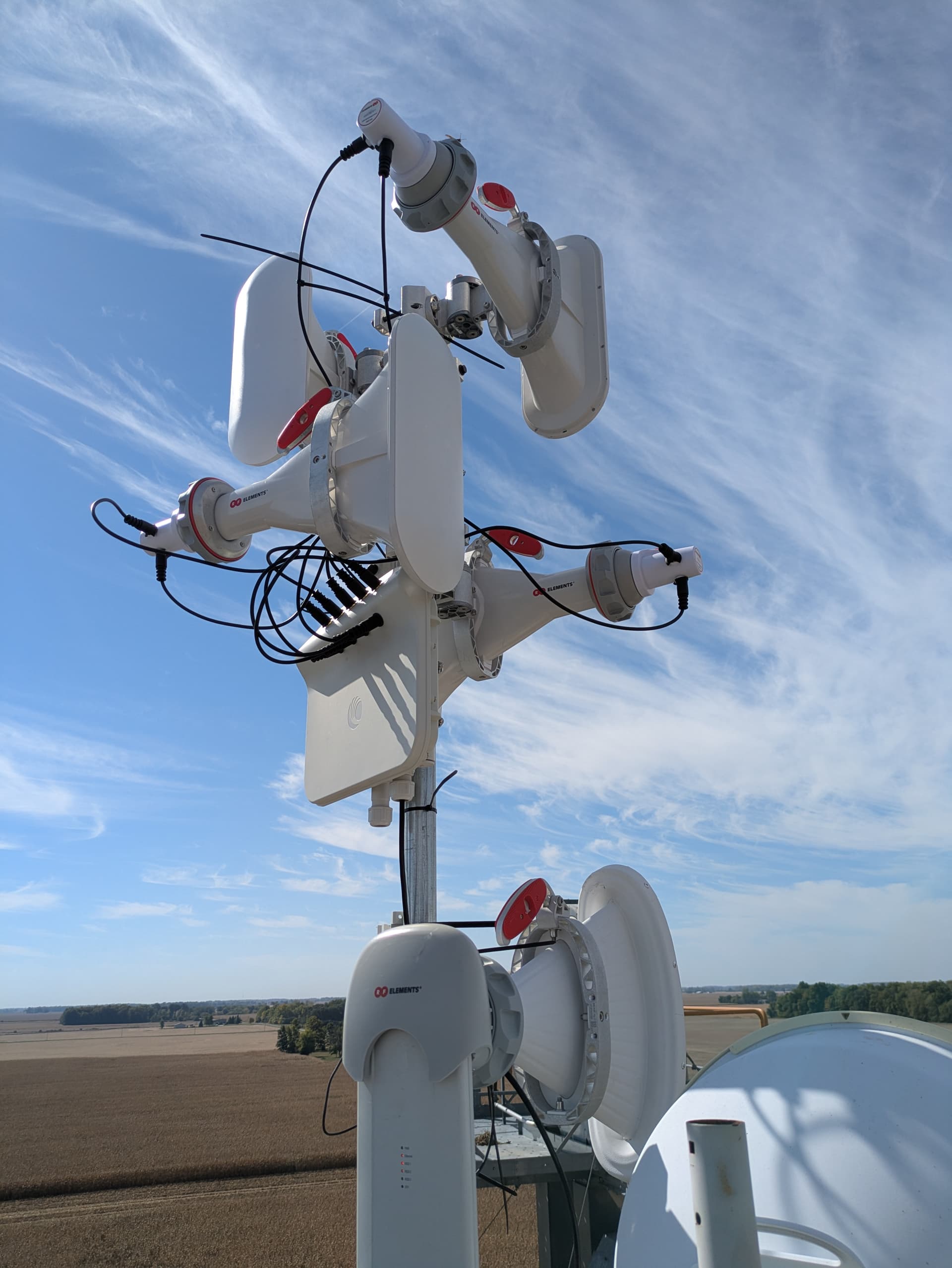
I recently put up a 4500c connected to four 90deg RF Elements Asymmetrical Horns in a NW/NE/SW/SE setup.
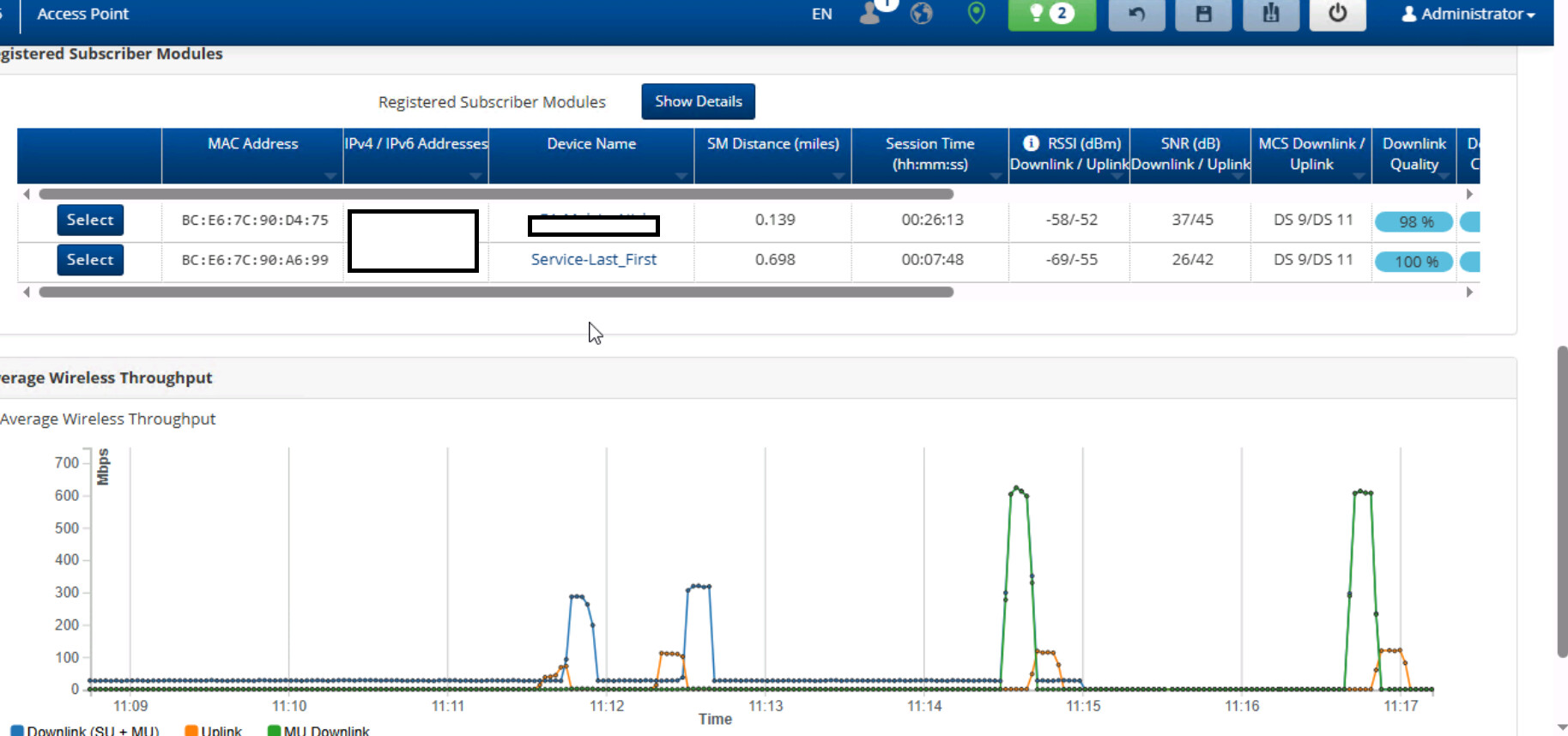
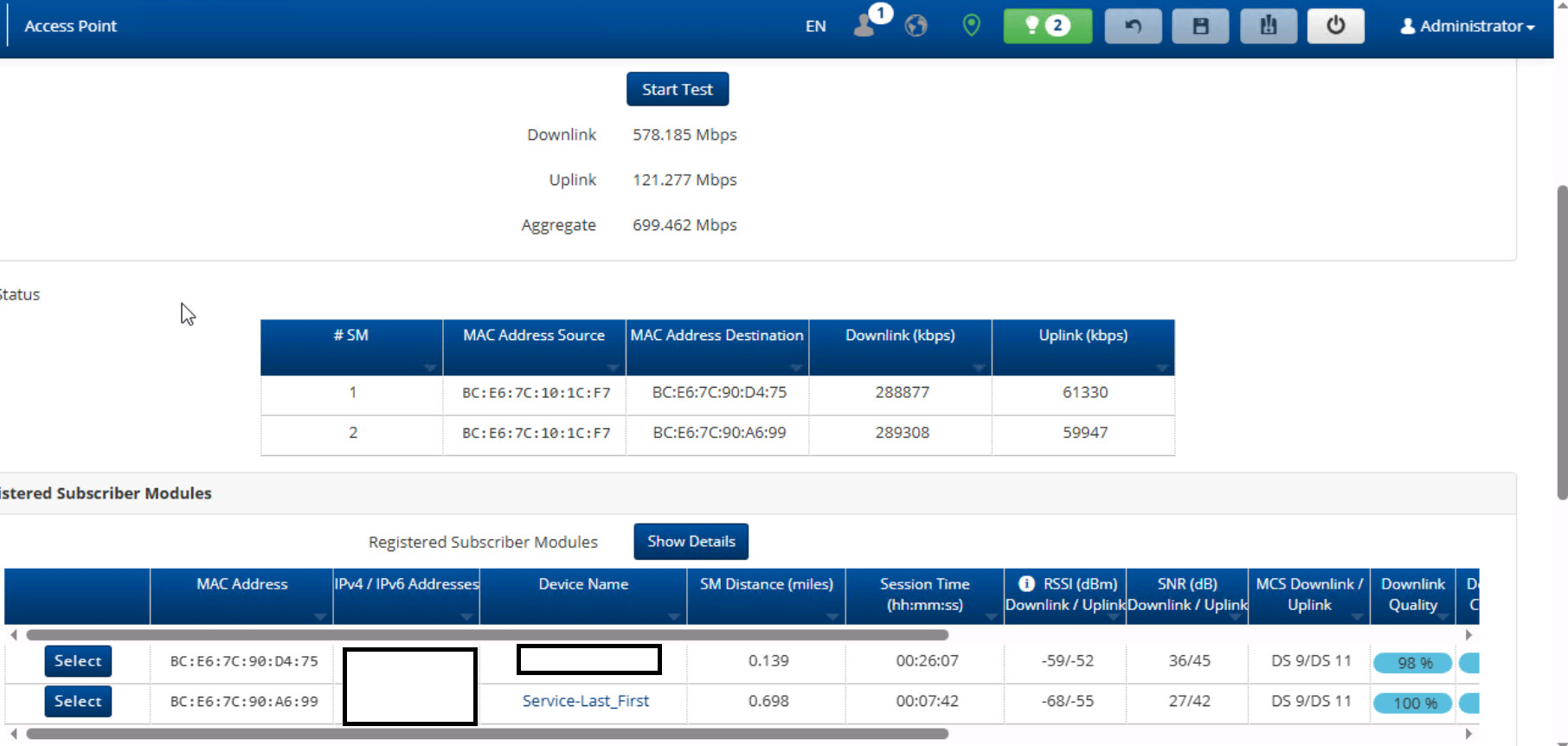
I went out and tested to one client that was under a mile to the SW with clear LOS and got a decent signal but a little lower than expected, but that could be my antenna aim (haven’t verified). SW AP is connected to AP H1+V1. What I found at this single client was that their DL rates were very unstable when idle and would bounce between DS 11 to DS5, but were a stable DS10/11 most of the time when under load. I have not seen that on my other 100+ 4625SMs or my other 4525SMs off other towers. The other towers are all traditional 4x4 or 8x8 sector setups.
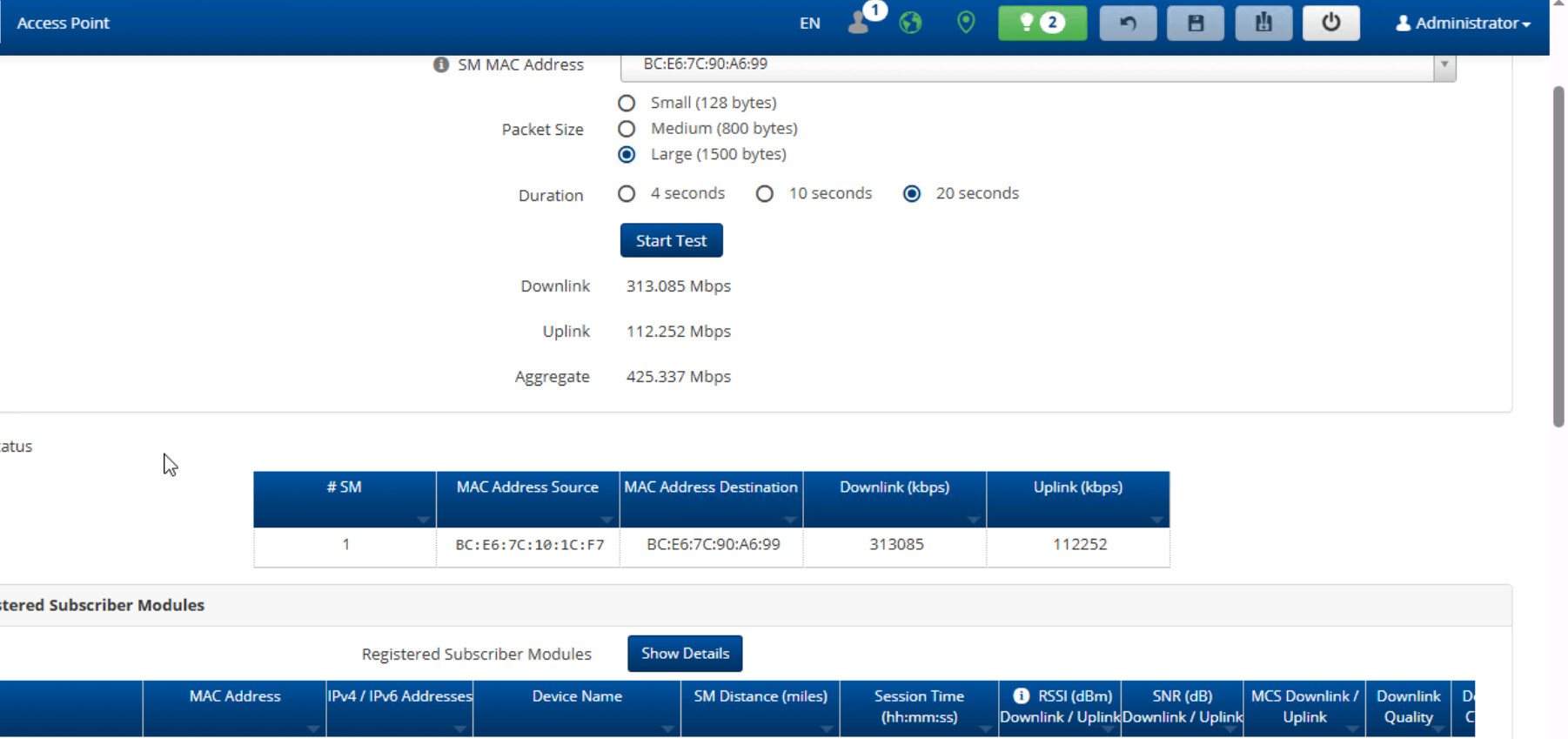
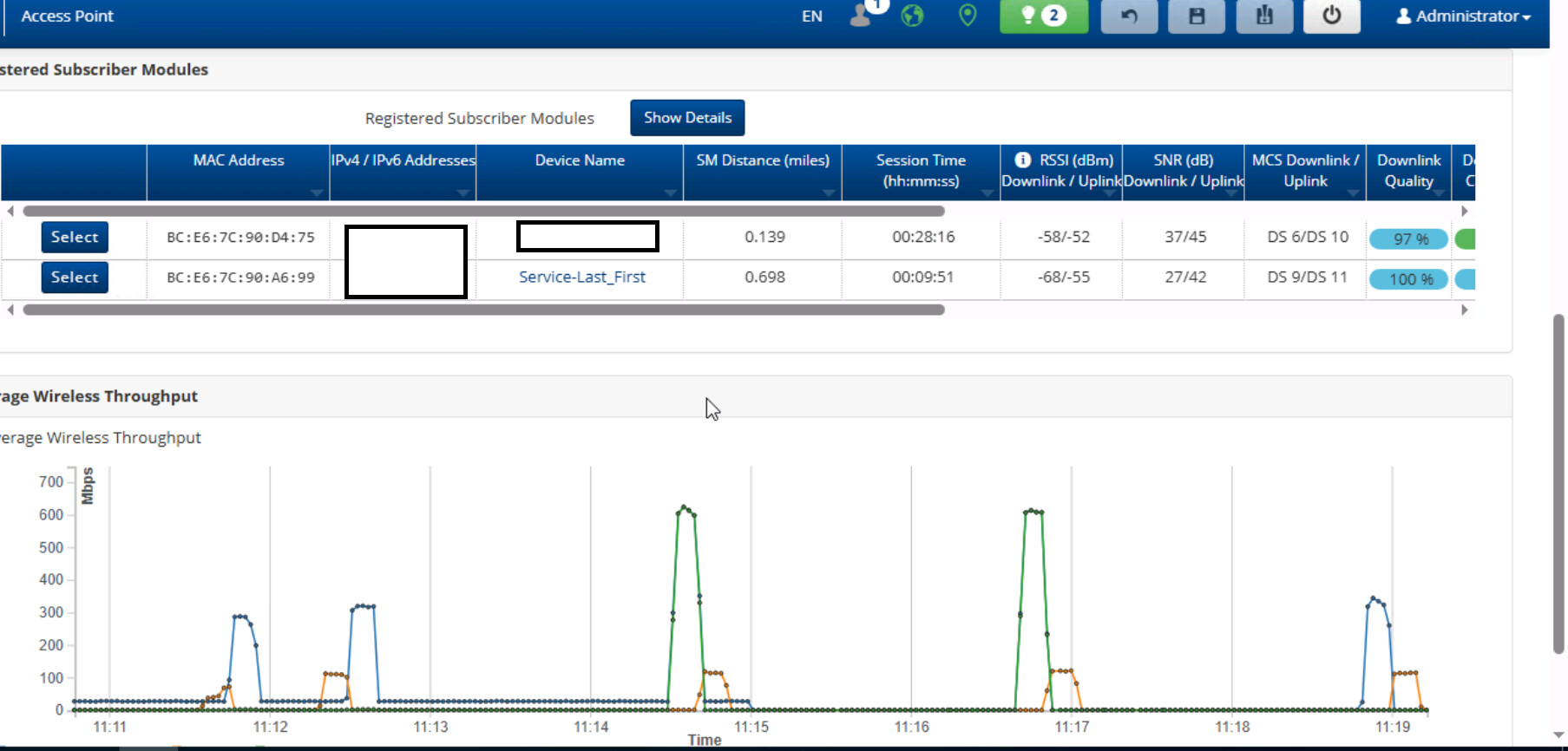
As another test I went to a different location to the NE at around 1 miles. It also had clear LOS. However the DL signal was way lower than expected, but the UL signal was as expected. DL signal was -69 with -51 UL. DL modulation rates like the other SM were unstable when the SM was idle. I thought it could be my antenna aim again, but I was confused because the SM was modulating at DS9-11 when active which should be impossible at -69 on 40mhz channel with 27SNR. Also, a single SM link test to the AP also showed that I was modulating at DS9-11 as I got over 300Mbps DL.
Is there something about using the 4500c in Omni mode where the reported signal for SMs not on connector H1+V1 on the AP get a false RX signal? The AP to the NE is connected to H3+V3.
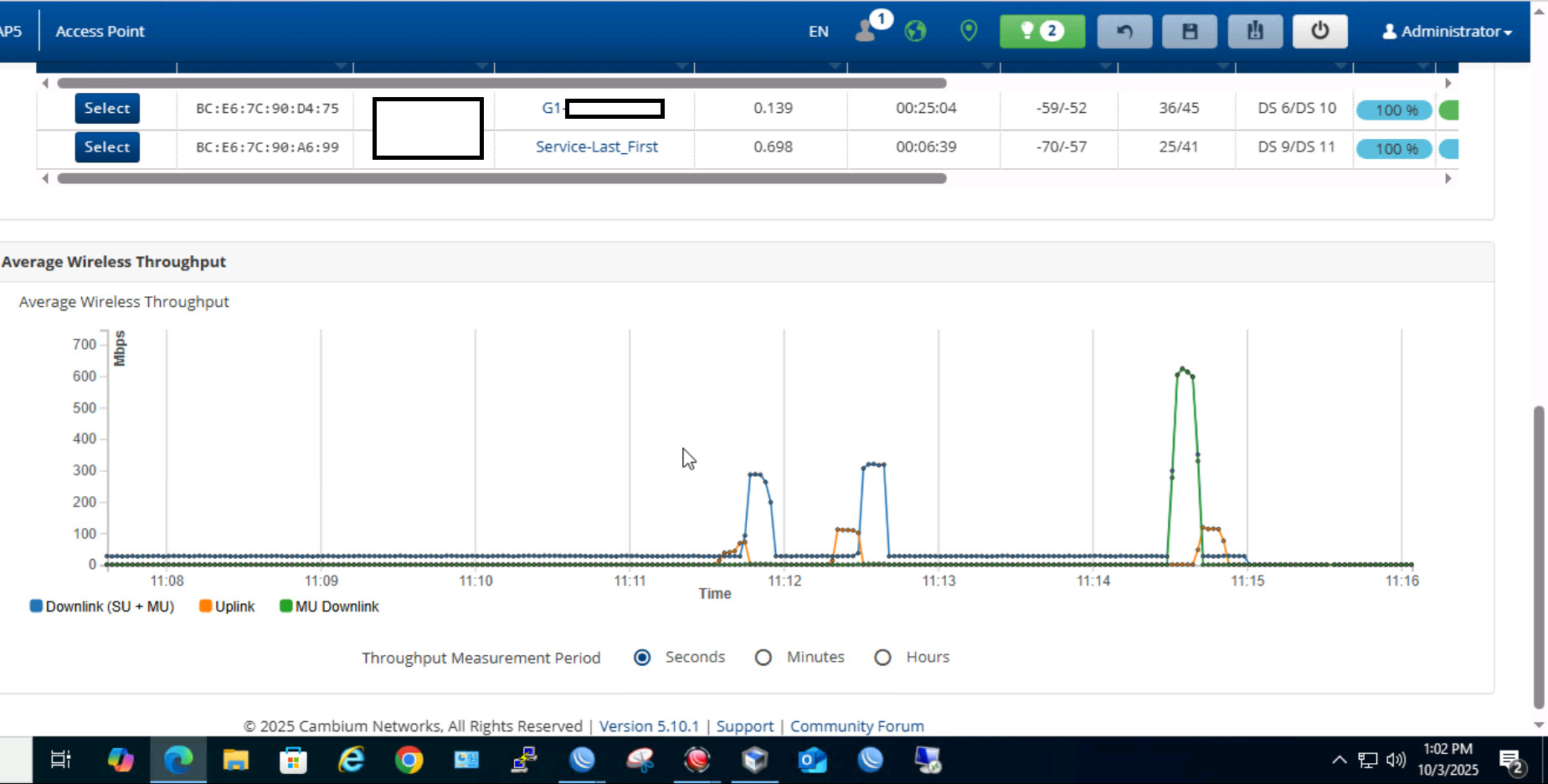
Another confusing thing was Cambium told me that MU-MIMO does not work in Omni mode, but I was able to test and MU-MIMO was working. I know it was working because 2 SM link tests showed AP was pushing 600Mbps at 40mhz and the AP bandwidth charts showed MU-MIMO (green) traffic.
I guess to boil it down I want to know why the following.
Why DL mod rates were unstable when idle unlike my sector based 4525/4625 SMs
Why RX signal on SM connected to a horn facing the opposite direction was low, but had good rates and performance (false signal)?
Why does MU-MIMO work in Omni mode when Cambium said it should not work?
Right now I am not sure I will keep this setup or not based on the results I got. While the MU-MIMO working was encouraging the unstable rates and odd signals are giving me pause on this type of setup.
I was already leaning in this direction, but since I did not get any response on if my results were expected or some type of oddity, I am removing the 4500c omni setup and going in a different direction. I was hoping this could be a good model for smaller tower sites, but too may odd things going on in my test setup to keep or expand this to other sites.
What happens when you try to do four concurrent speed tests, one from each sector?
Cambium MU-MIMO is supposed to use digital beam forming and null steering to create isolation between the stations so that the access point can send different signals to different stations at the same time. When you point the horns in different directions like this, then you create sufficient isolation for MU-MIMO to work without the beam forming. However, I think you should choose “split sector” instead of “omni”. I think “omni” implies that these are omnidirectional antennas with overlapping beams.
The advantage of a setup like this is that you don’t need to transmission synchronization between multiple radios because it is just one radio. The downside is that the spectrum analyzer only works on one chain, so you could encounter noise and interference that you can’t detect and avoid.
It’s a shame you’re not getting any vendor or community support. If you’re open to it, I am very interested to explore these types of setups with you to determine what is the optimal way to configure ePMP radios. I suspect the optimal configuration is narrow beam width 2x2 horns rather than 4x4 and 8x8 MU-MIMO radios.
Could you explain this a little better: “Cambium MU-MIMO is supposed to use digital beamforming and null steering to create isolation between stations, so the access point can send different signals to different stations simultaneously. By pointing the speakers in different directions like this, enough isolation is created for MU-MIMO to work without beamforming. However, I think I should choose “split sector” instead of “omnidirectional.” I think “omnidirectional” implies omnidirectional antennas with overlapping beams.”
Since I do more or less the same thing with the ePMP3000, using 27dBi or 24dBi Ultradisd or 24dBi Ultrahord antennas for long-distance links and limited coverage up close but broad coverage in the distance (meaning, for example, the Ultradish has a 5-degree beam).
Would MU-MIMO work for me if I separate the Ultradishes?
I’m currently using the omni/split sector option.
The results are very good with this type of configuration.
Each antenna port on the radio carries a distinct data stream. The ePMP 3000/4500/4600 MU-MIMO access points are designed to use antennas pointed in the same direction with overlapping beams, then precode the signals to create constructive and destructive interference for digital beamforming and null steering.
In their datasheets and product pages, Cambium advertises that 4×4 antenna arrays provide a 3 dBi gain improvement and 8×8 arrays provide a 6 dBi improvement. However, Qualcomm engineers told me that Wi-Fi digital beam forming only achieves about a 1.7 dBi gain improvement in the lab, which may not sufficiently isolate the data streams to allow the AP to communicate with two stations at the same time in real life. The AP makes MU-MIMO and OFDMA determinations at the time of transmission, and this happens at a low level on the Wi-Fi chip. When you point different antennas in different directions, you are manually creating isolation, which should allow MU-MIMO, but this is not how MU-MIMO was designed to operate.
Another problem is that the spectrum analyzer works for only two chains (chains 2 and 3 on a 4×4), which means you will encounter undetectable interference. That makes it impossible to know what is going on in the other sectors, so you can’t pick the best channel and change channels to avoid interference.
One of the big challenges for WISP vendors is that they developed their proprietary MAC-layer protocols (like ePMP) using open-source Wi-Fi drivers with 802.11n and 802.11ac. Starting with 802.11ax, Wi-Fi chip manufacturers began locking developers out with proprietary drivers and binary blobs. With each Wi-Fi generation, WISP vendors essentially have to rebuild their proprietary MAC-layer protocols and platforms from the ground up, without the same low-level access that they had in the past.
To me, “omni” implies using omnidirectional antennas to create a 360° coverage pattern with overlapping beams and digital beam forming. “Split sector” implies using sector antennas with non-overlapping beams without digital beam forming. Split sector should allow MU-MIMO. However, I don’t know whether it is possible for the Wi-Fi chip to enable MU-MIMO while disabling digital beam forming. That is a question for Cambium.