Once a WISP maxes out a tower or a sector with 30° sector horns, it is still possible to improve connectivity and add capacity by using overlapping sectors.
WISP sector antenna beam widths are commonly described as having 6 dB less signal at the edge of the beam compared to the center, where the antenna provides the most gain. A 15 dBi 90° sector antenna, like RF Elements AH90WB, only functions like a 9 dBi antenna for a station positioned 45° from the center of the beam.
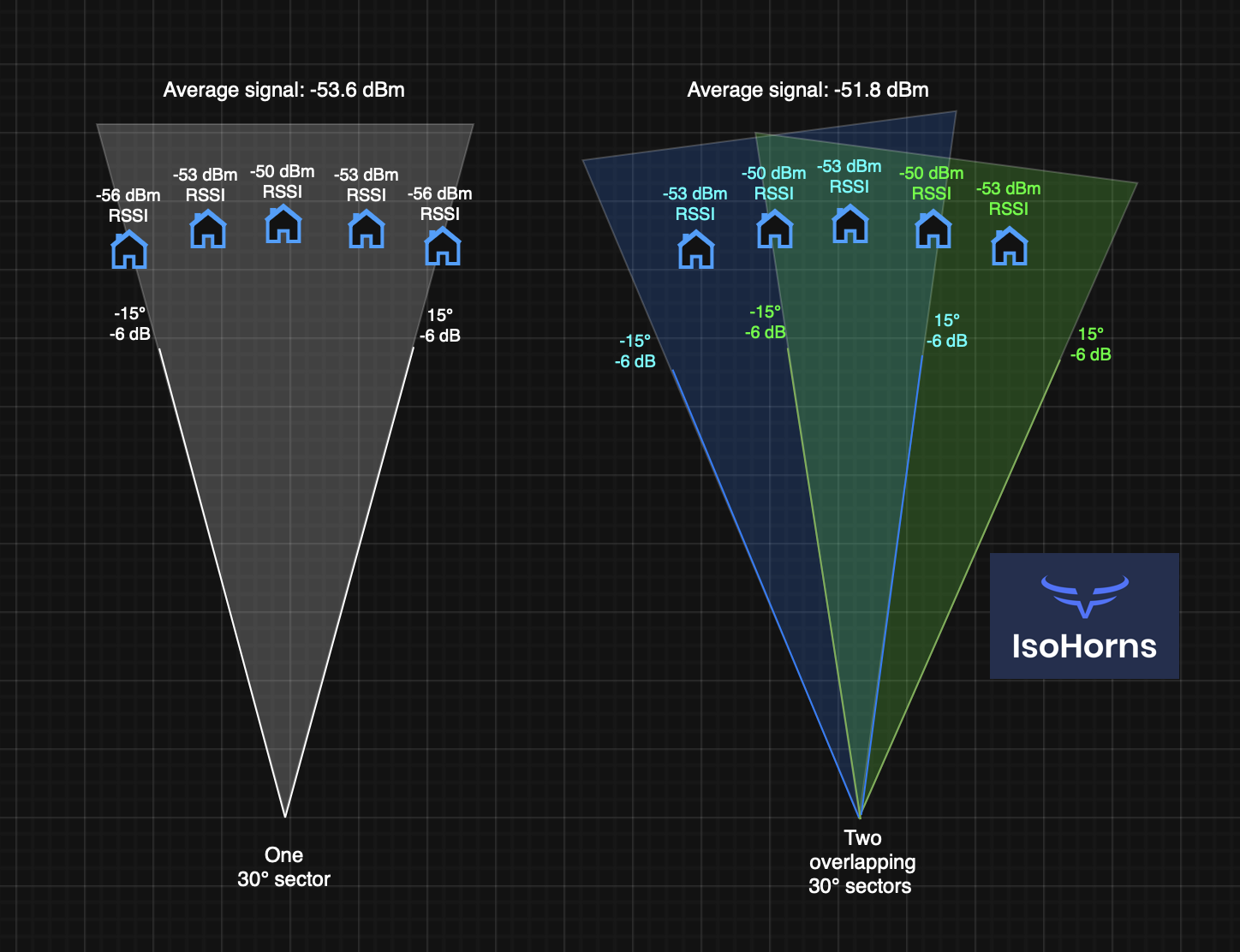
This diagram shows 30° horns being used to serve the same five subscribers. The white sector represents a single horn, while the blue and green sectors represent two 30° horns offset by 15° and operating on different channels.
The centers of the sectors are where the signals are strongest, and the edges have a -6 dB drop relative to the center. With two overlapping sectors, there are two beams, and stations are, on average, closer to the centers of those beams where the signals are strongest.
This is how WISPs can use overlapping sectors to improve overall subscriber connectivity and add capacity, even without dividing sectors.
Of course, I wouldn’t be doing my job if I didn’t also mention that IsoHorns has the top performing 30° sector horn antennas in the WISP industry, specifically designed to help WISPs scale up the capacity and performance of their PtMP networks.  Available here: [BUY] ePMP 4600L PtMP 30° horn antenna by IsoHorns