Applicable platforms: AX
Applicable versions: 5.11.0 and above
New feature introduces TCP ACK Pacing support for TDD driver mode on the Access Point (AP). This feature optimizes the flow of TCP acknowledgment packets in the uplink direction to mitigate the impact of TCP microbursts. A microburst can be observed where link speed changes occur along the transmission path. Example path: TCP server - 10G Ethernet - 1G Ethernet - Wireless TDD PMP link - Client.
The feature is disabled by default.
Notice:
Throughput degradation may be observed in scenarios where TCP microbursts are not present.
GUI >> Configuration >> Network >> Advanced:

Template for CnMaestro:
{
    "device_props": {
        "tcpPacingEnable": "1"
    }
}
SNMP MIB Object:
tcpPacingEnable OBJECT-TYPE
    SYNTAX        Integer32 (0|1)
    MAX-ACCESS    read-write
    STATUS        current
    DESCRIPTION
        "Enable TCP ACK pacing on egress interfaces:
            0 - Disable,
            1 - Enable
        Device Allocation: AP"
    DEFVAL { 0 }
    ::= { cambiumTcpPacing 1 }
A TCP microburst is a very short, sharp spike in network traffic where a large number of packets are sent or received in milliseconds (or microseconds), often exceeding the network’s average capacity and causing congestion and packet loss. These are frequently caused by the way TCP handles multiple simultaneous connections and can lead to performance issues like delays, retransmissions, and drops, especially for time-sensitive applications. Detecting them is difficult because it requires very high-granularity monitoring that standard tools (NMS, SNMP, ping, etc.) often lack. The issue is especially noticeable with multiple link speed changes along the transmission path.
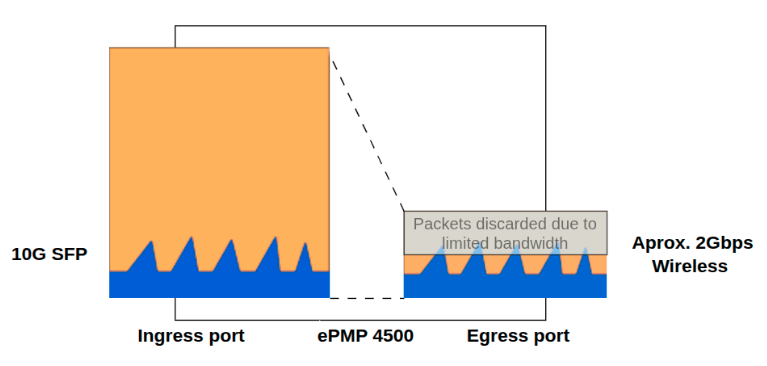
Why Microbursts Are Problematic in TDD PMP Networks
- Slot-based transmission – Data can only be sent during scheduled UL/DL slots, forcing bursts to queue and causing latency spikes.
- Limited AP/SM buffers – Small queues can overflow, causing drops and TCP back-off.
- Shared medium – Multiple subscribers compete for the same airtime when bursts occur.
- Dynamic DL/UL ratio and MCS – Bursts during low-rate or UL-heavy frames intensify congestion.
- Impact on real-time traffic – TCP bursts can starve VoIP/gaming and other latency-sensitive flows.
Observable Effects
- Latency spikes
- Buffer occupancy surges
- Packet loss and retransmissions
- Reduced aggregate throughput
- Uneven subscriber experience
- Low test results with Ookla, fast.com, speed.cloudflare.com
Other Recommended Strategies
- Use TCP BBR congestion control on servers (e.g., Ookla Speedtest).
- Use a TCP proxy such as Cambium QoE.