Applicable versions: 5.11.0 and above
Applicable platforms: AC, AX
ePMP AX and AC radios in Subscriber mode add control over two PPPoE-related parameters: Encryption and Compression. Both parameters can now be independently enabled or disabled, giving operators more flexibility in balancing performance, compatibility, and security.
This controls were introduced to resolve inconsistencies in PPPoE session behavior caused by the tight coupling between compression and encryption within CCP negotiation. After compression support was removed in earlier implementations, devices could no longer properly negotiate MPPE encryption, leading to failed session establishment when encryption was required or to tunnels coming up without actually enabling the configured features. By adding explicit control over both compression and encryption, the system now allows predictable negotiation outcomes, improves interoperability with devices such as MikroTik, and gives operators clearer control over performance versus feature usage.
The optimal configuration is to keep both encryption and compression disabled
This allows full use of hardware acceleration and delivers maximum throughput with minimal CPU load.
Enabling compression introduces processing overhead and may provide limited benefit depending on traffic patterns.
Enabling encryption, traffic acceleration is no longer supported because the system cannot inspect encrypted packet headers, resulting in increased CPU utilization and reduced throughput. Therefore, while encryption can be useful for specific security requirements, it comes at a clear cost to overall performance.
GUI >> Configuration >> Network >> Point-to-Point Protocol over Ethernet (PPPoE)
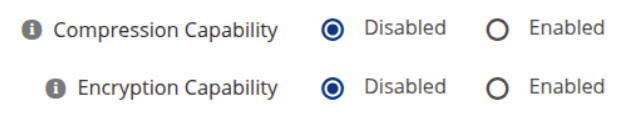
| Setting | Status | Details |
|---|---|---|
| Encryption Capability | Disabled | nomppe option is enforced |
| Enabled | Encryption negotiation is allowed | |
| Compression Capability | Disabled | noaccomp, nopcomp, nodeflate, nobsdcomp, novj, novjccomp options are enforced |
| Enabled | Compression negotiation is allowed |
noaccomp – Disables Address and Control Field Compression (ACFC) in both directions (transmit and receive). PPP can compress the Address and Control fields of the frame header to reduce overhead ( RFC 1661). This option forces those fields to remain uncompressed.
nopcomp – Disables Protocol Field Compression (PFC) in both directions. PPP can compress the 2-byte Protocol field into 1 byte when possible (RFC 1661).Option prevents its negotiation and use.
nomppe – Disables Microsoft Point-to-Point Encryption (MPPE).MPPE is a Microsoft-specific encryption mechanism for PPP links (RFC 3078). Encryption is neither requested nor accepted.
nodeflate – Disables Deflate compression. Prevents PPP from negotiating Deflate-based compression (based on the zlib/DEFLATE algorithm)(RFC 1979).
nobsdcomp – Disables BSD-Compress compression. Stops PPP from using BSD-Compress, a compression scheme derived from Lempel-Ziv algorithms, defined in RFC 1977.
novj – Disables Van Jacobson TCP/IP header compression in both directions. This compression reduces the size of TCP/IP headers over low-bandwidth links (RFC 1144).
novjccomp – Disables connection-ID compression within Van Jacobson header compression. When VJ compression is enabled, PPP may omit the connection ID byte to save space. This option ensures the connection ID is always included and prevents negotiation of its omission ( RFC 1144).
Related MIB Objects
networkWanPPPoECompression OBJECT-TYPE
	SYNTAX	   Integer32 (0|1)
	MAX-ACCESS read-write
	STATUS	   current
	DESCRIPTION
		"Enable PPPoE Compression
		0 - Disable
		1 - Enable
		Device Allocation: SM
		Platform: 802.11AC, 802.11AX"
	DEFVAL	{ 0 }
	::= { networkWan 19 }

networkWanPPPoEEncryption OBJECT-TYPE
	SYNTAX	   Integer32 (0|1)
	MAX-ACCESS read-write
	STATUS	   current
	DESCRIPTION
		"Enable PPPoE Encryption
		0 - Disable
		1 - Enable
		Device Allocation: SM
		Platform: 802.11AC, 802.11AX"
	DEFVAL	{ 0 }
	::= { networkWan 20 }
cnMaestro template
{
	"device_props": {
		"networkWanPPPoECompression":	"0",
		"networkWanPPPoEEncryption":	"0"

	}
}