Hi..is there any cambium radio that i can that I can use for backup in case Tower A gets off Tower B can back it up and vice versa..almost like a ring connection
Hi @Jane_Katassi,
Just to make sure I understand correctly—could you share a network diagram to illustrate what you’re aiming to achieve?
If you’re referring to a backup access point for a subscriber, we can configure a list of access points. The subscriber will then connect or failover between them based on your preferred pattern, providing redundancy during maintenance or outages.

I need help with a ring backup setup.
Let’s say Tower A backs up Tower B via microwave. If fiber on Tower B is down, Tower A should carry the traffic.
Question:
Can one Cambium Force radio work as both Master and Slave at the same time?
Or must I install 2 pairs — one pair with Master on A / Slave on B, and another pair with Master on B / Slave on A?
Please advise.
Thanks
Hi @Ronald_Reimer,
If I understand your use case correctly, you are looking to implement a network redundancy scenario where, for example, if the fiber connection on Tower B goes down, the traffic is automatically redirected through Tower A, and vice versa.
If this is your intended topology, then this type of failover can be achieved using a routing protocol such as OSPF.
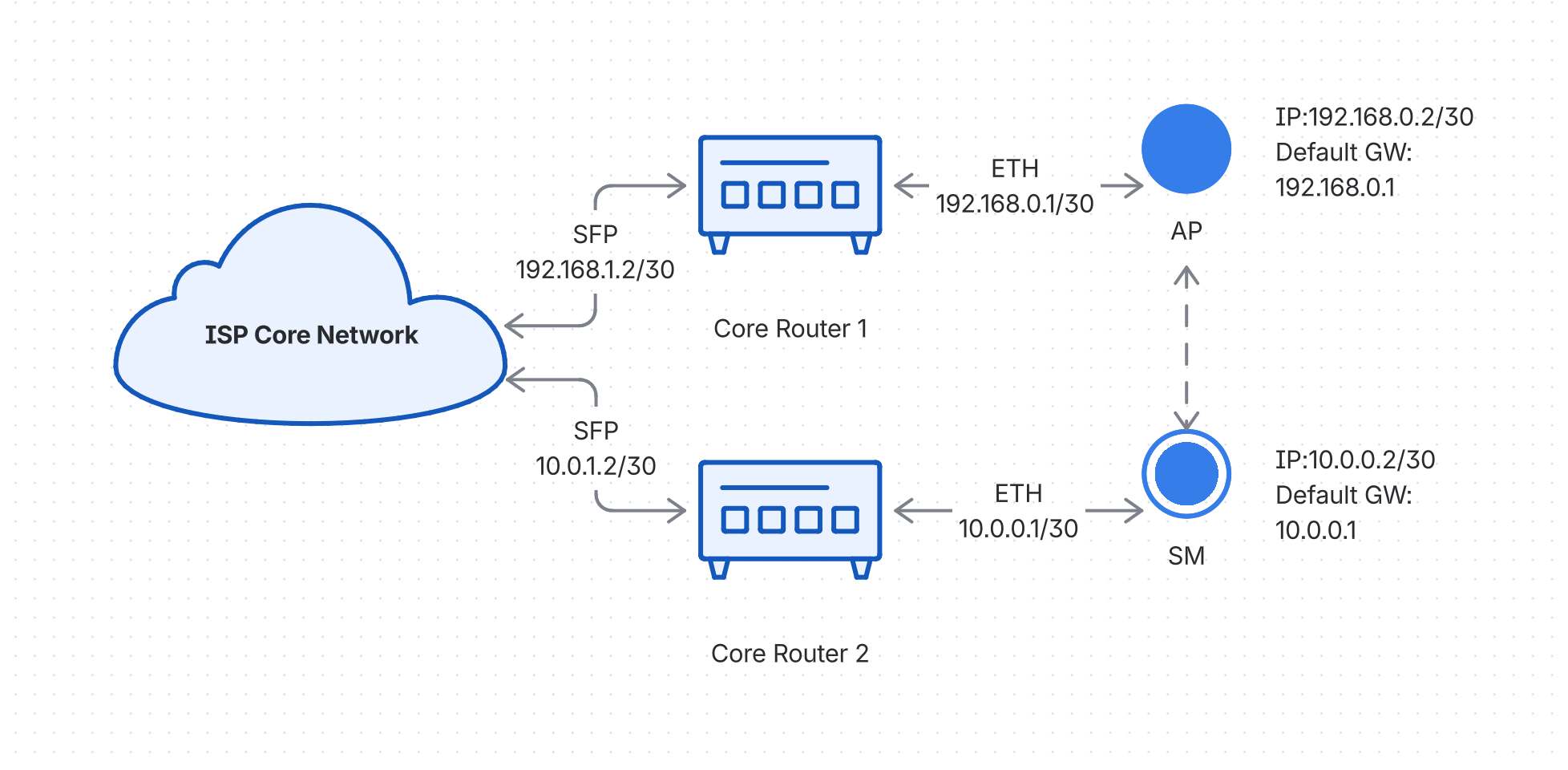
Regarding your original question, a single Cambium radio cannot operate as both a Master (AP) and a Slave (SM) at the same time. Each radio can operate in only one wireless role at a time.
If our understanding of your use case is correct, you should not need a second AP/SM pair solely for routing failover. Instead, the redundancy would be handled by the routing protocol, while the wireless link continues to operate as a single point-to-point connection.
If your intended topology is different, please let us know or share a simple network diagram, and we will be happy to recommend the most appropriate solution.
No, they can’t. BUT both a Master and a Slave are both perfectly happy to send and receive information either direction.
For example, if your link is set to 50%/50% duty ratio (or if it’s set to Flexible Frame, or set to ePTP Mode) then there’s very little performance difference with data going from A to B, or from B to A.
So, I think you can accomplish what you’re asking with routing, and a single link between A-B in Flexible Frame or ePTP should be happy to carry data either direction as the routing requires it to.