The real reason Cambium ePMP 4600 WISPs experience poor range on their 6 GHz PtMP links, particularly in relation to uplink connectivity, is that they are 1) using low-gain sector antennas and 2) subject to automatically enforced EIRP limits on integrated CPEs.
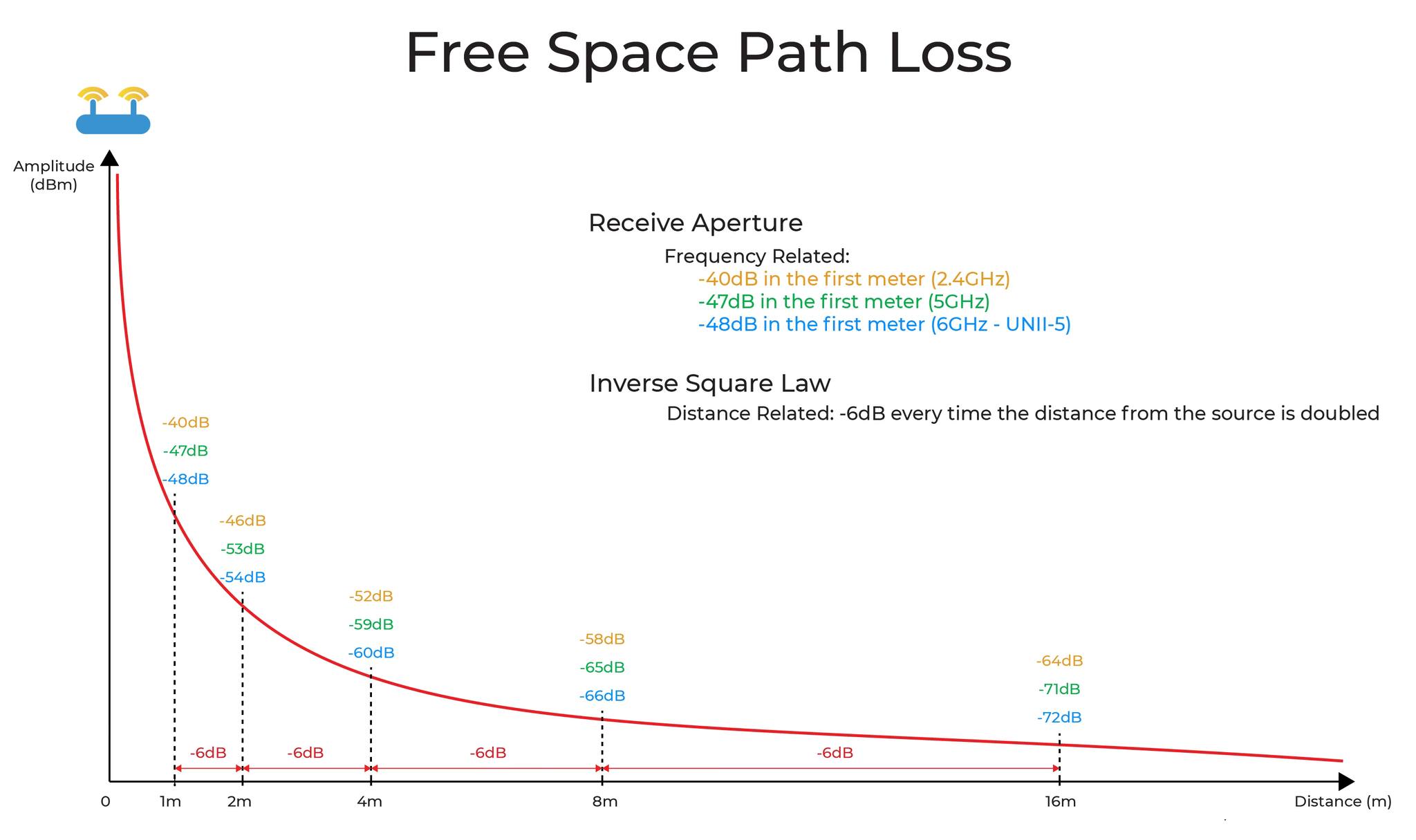
The difference in free-space path loss between 5 GHz and 6 GHz is only about 1.6 dB. Every time the link distance doubles, the signal strength is reduced by 6 dB. Decibels are relative measurements, so it doesn’t matter whether the link distance is 1 m or 100 km; there is still only about a 1.6 dB difference between 5 GHz and 6 GHz.
The reason WISPs perceive a big difference in 6 GHz PtMP applications is that they are using low-gain 6 GHz sector antennas (often originally tuned for 5 GHz), and the EIRP limits are automatically enforced with CPE devices that have integrated dishes, such as the ePMP Force 4625.
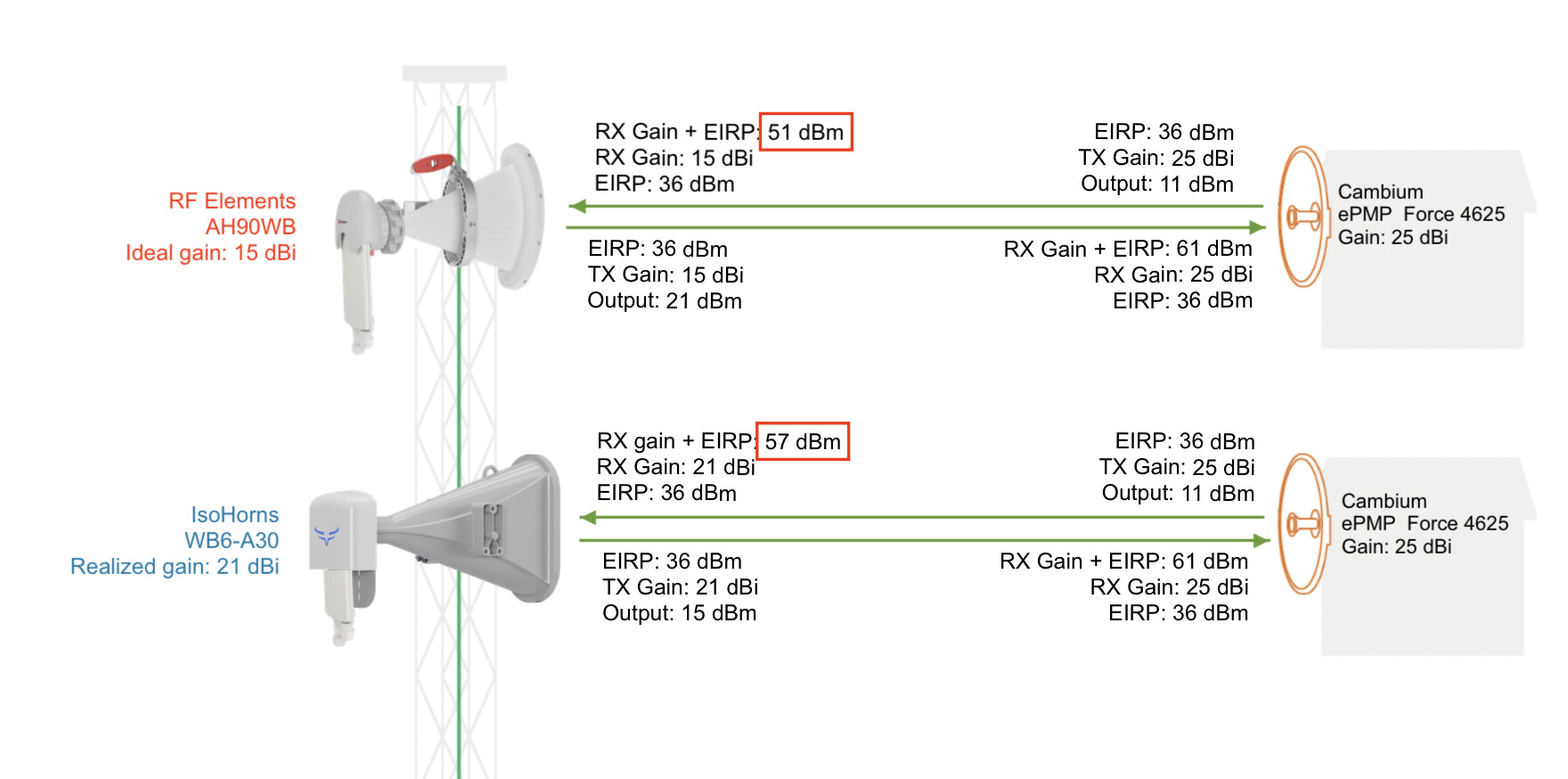
The 6 dBm difference in uplink received signal strength indicator (RSSI) between the AH90WB and the WB6-A30 means that the IsoHorns 30° horn can achieve roughly twice the range and at least two levels higher modulation and coding scheme (MCS) rates. The narrow beamwidth of the IsoHorns 30° asymmetrical horn also reduces the amount of noise the radio receives, further improving SNR for longer range and higher modulation rates.
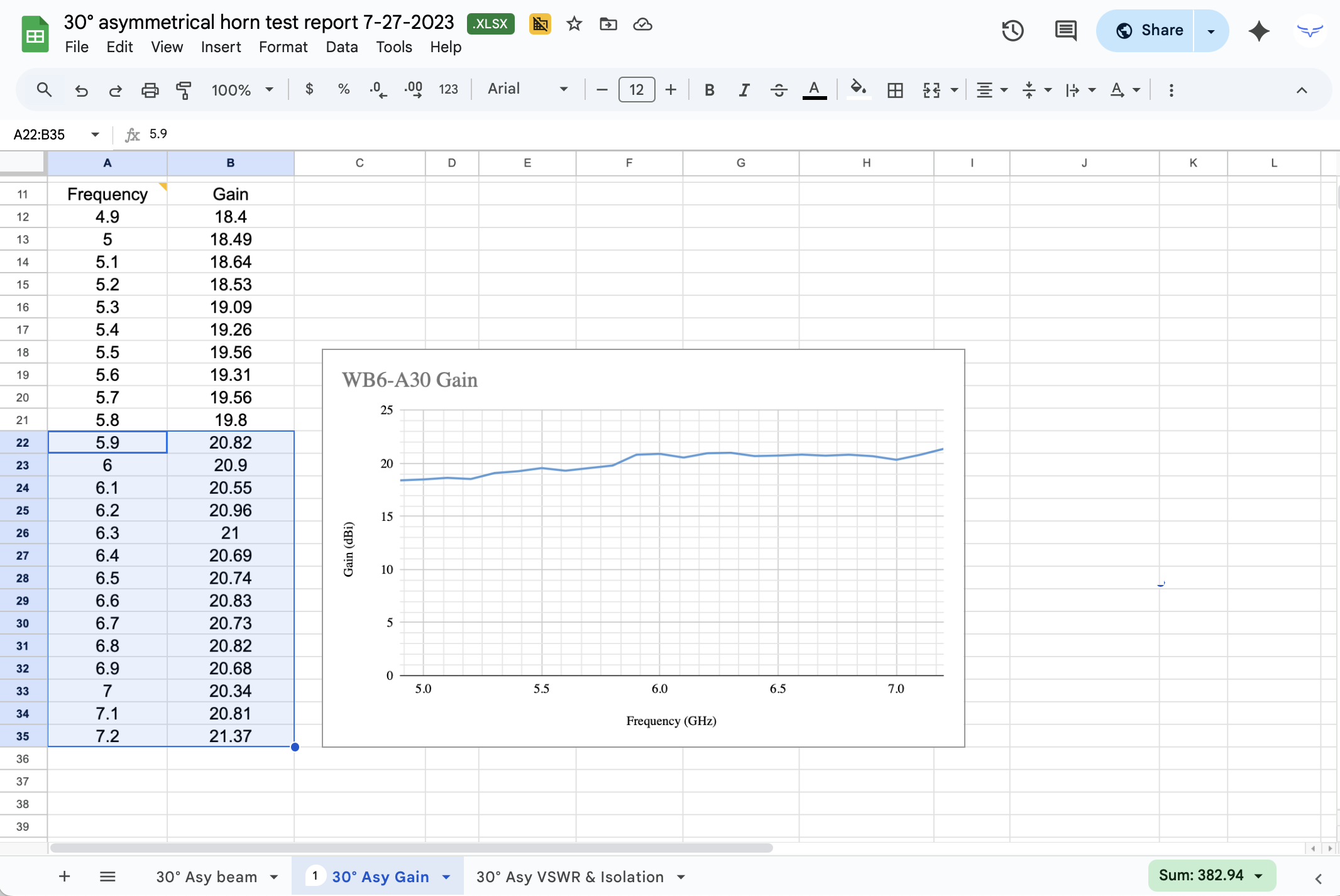
The most practical solution is to increase the gain on the AP sector antennas so they can better receive a signal from the station with limited output power, and one of the best ways to do that is with IsoHorns 30° high-gain horns, which provide 20–21 dBi of measured gain from 5.9–7.2 GHz.
There is some good info here, that a lot of people do seem to be unaware of.
To put it simply, in 6ghz, the uplink signal will pretty much always be weaker than the downlink signal (at least until the ePMP 4616 is available). Since the EIRP limit is the same for both the AP and SM, you’re going to have a difference in uplink/downlink signal equal to the difference in antenna gain between the AP and SM.
If you’re using a 16dbi horn on the AP and a Force 4625 SM (25dbi), it’s completely normal and expected for the uplink signal to be about 9db weaker than the downlink signal.
And yes, the only way to fix that is to use a higher gain antenna on the AP, but unfortunately, 30 degree coverage isn’t always practical.
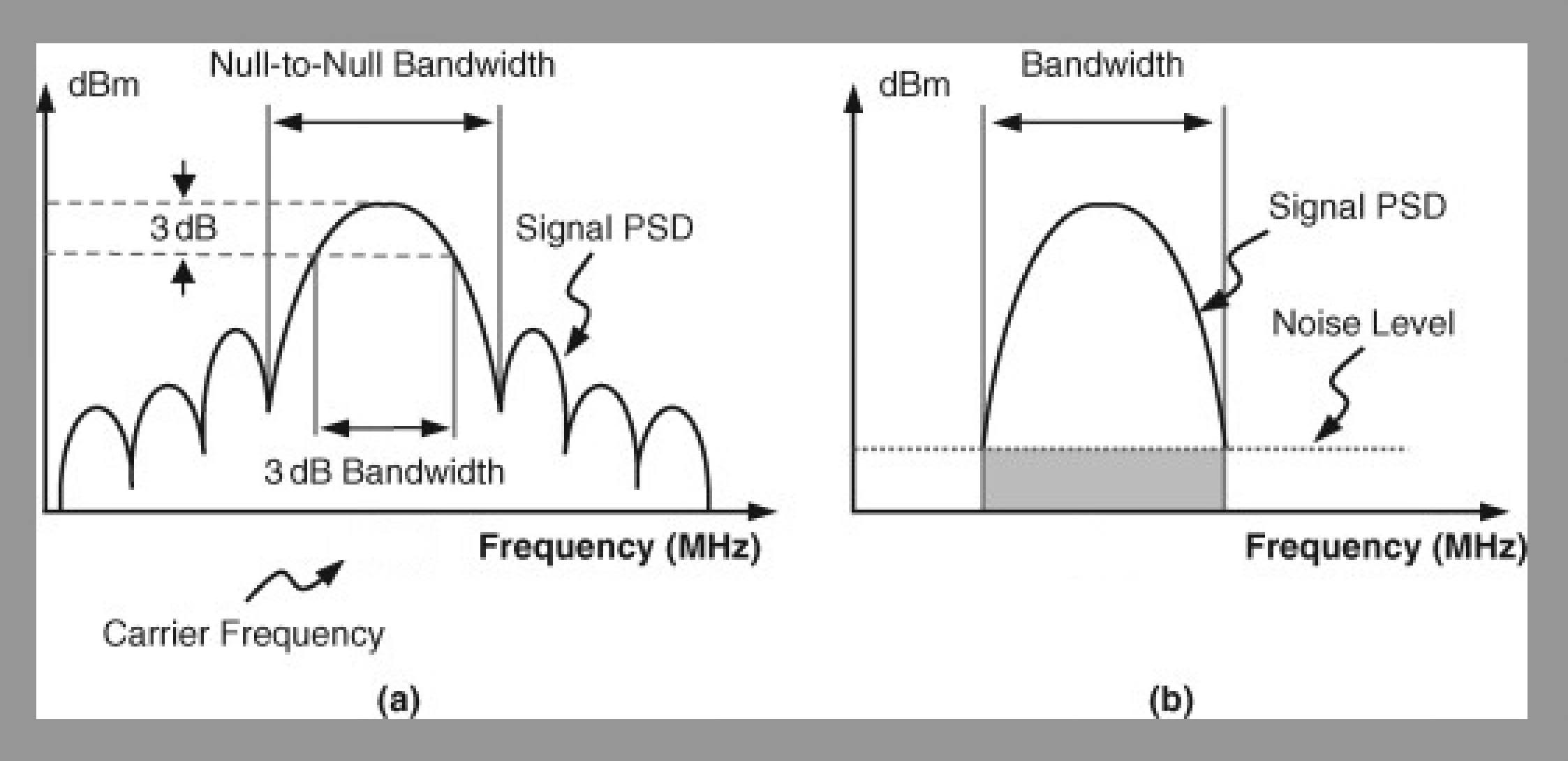
Asymmetric channel widths is a good solution. Reducing channel width is very similar to reducing beam width in terms of lowering the amount of noise a radio receives, as shown in this graphic.
Although the graphic resembles an antenna radiation pattern illustrating how narrower beam widths reduce susceptibility to noise, it actually demonstrates how narrower channel widths achieve the same effect.
RF Elements has set up WISPs to fail. For 10 years, RF Elements told WISPs that gain was not useful on sector antennas and that horn antennas performed well in noisy environments because they supposedly had “no side lobes.”
In a June 24th, 2016 blog post subtitled “Why Good Guys Have Horns ..and the bad guys sell you ‘dBi dream’” RF Elements’ Juraj Taptic emphasized:
INCREASING ANTENNA GAIN ACTUALLY IS THE LAST THING [WISPS] SHOULD DO
In reality, 30° horn antennas perform well in noisy environments due to their narrow beam widths—and beam width is directly related to gain.
IsoHorns has not only had to overcome a decade of self-serving misleading marketing, but also a coordinated effort to censor us. Despite that, I think we’ve remained remarkably chill and focused on our message about how antennas actually work.
To overcome noise, WISPs actually want high-gain antennas with narrow beam widths, combined with narrow channel widths.
When upgrading only one side of a link from RF Elements antennas to IsoHorns or Cyber Antennas, WISPs typically see about a 3 dB improvement compared to comparable RF Elements antennas. When both sides of the link are upgraded, this results in a 6 dB improvement, effectively doubling the link’s range.
You’re comparing a 90 degree coverage horn to a 30 degree coverage horn? So, for 360 degree coverage, an operator needs to buy 3x the number of horns and radios. Now who is self-serving? Please, share more apple and orange comparisons.
On June 5th, 2019, in a Reddit WISP group comment, without disclosing that he was the product manager for RF Elements, Tomas Zvolensky said, “In general you want to have as small of a gain as possible on the side of AP, high gain, if anywhere, should be on the side of the CPE."
That is self-serving. It is also the cause of the problem I outlined in this post.
Two IsoHorns WB6-A30 horns with two 2x2 ePMP 4600L radios cost about the same as one RF Elements AH60WB-4x4-SMA and one 4x4 ePMP 4600 radio, but will deliver considerably better performance. This is not only because the 30° horns have more gain and can communicate with two stations at the same time (what MU-MIMO is supposed to do), but also because it will be easier to find clear channels due to the narrower sectors and because using two different channels doubles the available channel width. In addition, 30° sectors pick up about 3 dB less noise than 60° sectors and are less susceptible to interference. Also, with two beams, on average, the stations will be closer to the center of the beams, where the signals are strongest and the chains are most balanced.
Those are facts. Calling facts “self-serving” is a strange accusation.
For over two and a half years, some RF Elements fans have been pretending to be offended by facts to protect RF Elements’ honor. It is almost 2026. I can’t speak for everyone, but I can speak for myself, I’m tired of it.
Your pulling numbers out of the air here. Making the statement 3db less noise than a 60 degree horn is an utter fallacy. Noise comes from specific other points, it’s in the antenna pattern, or it isn’t. I can give you examples of -65 noise floors on a 30 degree horn, and -96 on the 120 degree sector. Environments change, and everyone is unique. Horns have their places, and are not an end all be all option. They scream to horizon and themselves create noise well beyond the anticipation cell radius, and have massive dead zones in near site coverage for examples.
Compare 30 degree antenna, to 30 degree antenna and you’ll have more listen, maybe. I see many of your posts bashing other products and stating claims, very few to no demonstration of claims.
Here are two sector antennas pointed in the same direction. One is a 90° antenna and the other is a 60° antenna. Despite higher gain, the 60° antenna receives about 3 dB less noise than the 90° antenna when operating on the same channel with the same channel width. This is because the 60° sector has a more narrow beam width.
They scream to horizon and themselves create noise well beyond the anticipation cell radius, and have massive dead zones in near site coverage for examples.
Sector bloom and null zones under the tower are both problems that should be solved with down tilt, not low gain antennas.
You ran into the situation once, doesn’t make it a blanket true statement. Further those old airmax antennas are junk, not at all comparable to some like KP performance, Alpha, or most OEM antennas now. Again, miss leading.
Null fields will always be an issue out of angle, but the horizon shot of a horn is a constant problem without creaming horizon nulls on your pattern with a flashlight like beam pattern. Horns have a place, they’re far from an end all be all. Truth in claims is important, proving a product is better than bashing another. Work on your marketing skills.
In science you start with a hypothesis like “narrow beam width antennas pick up less noise than wider beam width antennas” and then you run the experiment and measure the results.
It doesn’t matter if the antenna is a dish, sector panel, or horn, narrow beam widths will pick up less noise than comparable antennas with wider beam widths.
Dude, nobody cares about your feud with RF Elements and you aren’t doing yourself any favors by constantly trashing them - it’s only making you look bad. They make a decent product, and everybody that has used them knows that. Are there better options? sure, probably, but there are also a lot worse options out there.
Posting that Reddit comment without context is not fair. Based on the date, it’s pretty obvious that it isn’t talking about 6ghz, since that wasn’t a thing in 2019. There actually is a very good argument for using low gain antennas on the AP in 5ghz, where the clients are able to run at higher power to compensate. It’s not good advice in every situation, but in a noisy environment, turning up the transmit power on the CPE and decreasing the antenna gain on the AP absolutely can result in a higher signal to noise ratio.
In some cases, yes using 30 degree antennas is a good option. We have some of situations where 90 degree isn’t even practical (because of population density) and our choices are to either put up an omni or nothing. I can’t justify putting up 12 APs and 12 horns to potentially serve 8 customers. Different situations require different solutions.
That’s not real. There is no exception to EIRP for PtMP stations in 5 GHz. That is a self-serving urban legend perpetuated by certain vendors.
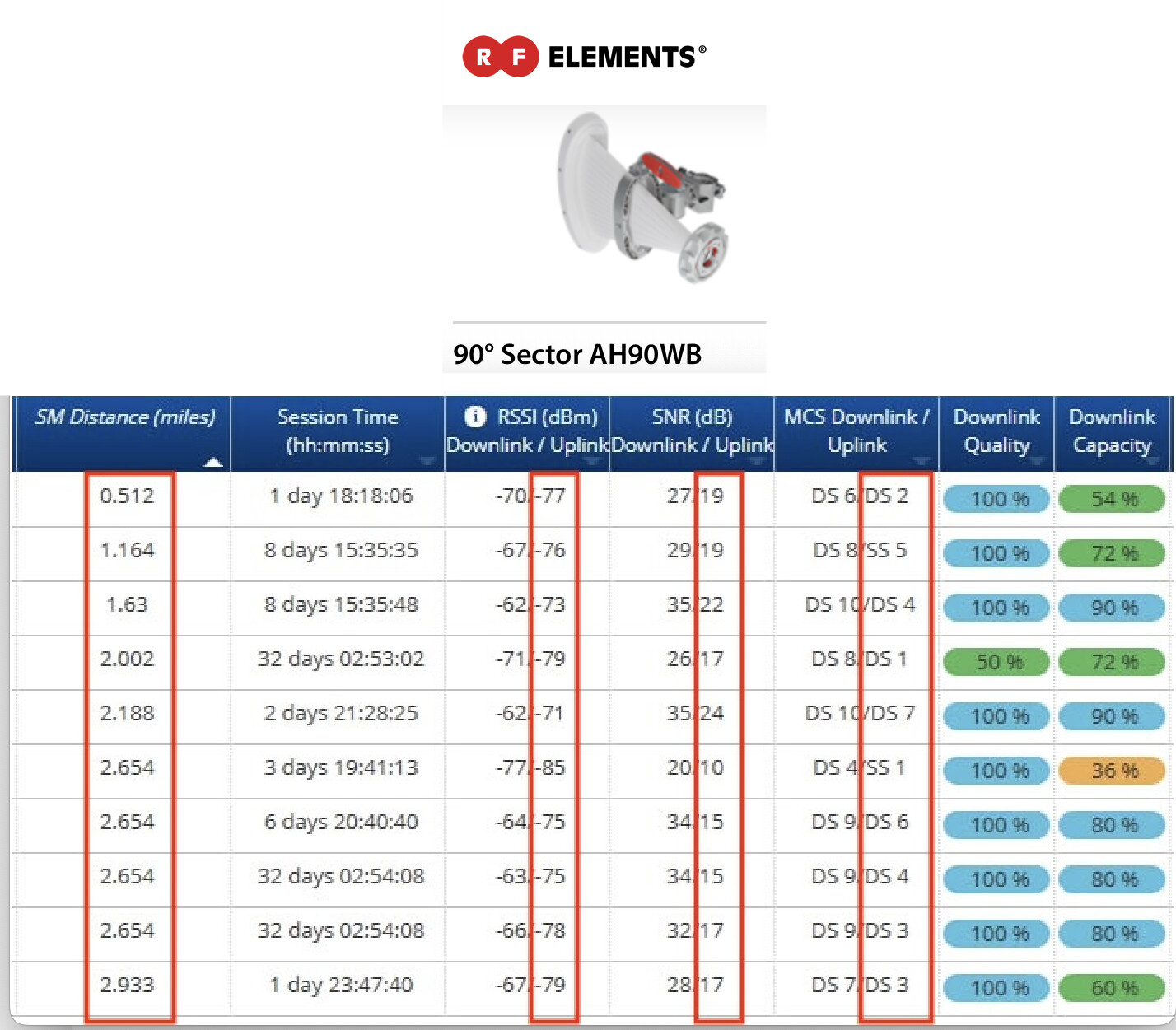
The context makes it even worse. This was a WISP trying to connect distant subscribers down in a valley from a tower on top of a ridge. RF Elements product manager, without disclosing that he was affiliated with RF Elements, told him to use low-gain antennas to avoid noise. Given the included picture in the post, proper answer would have been to use high-gain dish sectors.
@Chris_Bay@Mathew_Howard Believe it or not, many WISPs simply want high quality products that perform as promised, They use Cambium products to build profitable businesses and they engage the community to learn how to best use those products to stay competitive. They don’t care about “building up the community” or “marketing” or any of that.
Since every vendor out there has been going with the interpretation of the FCC rules that the PtP EIRP exception as applying to PtMP stations for years and selling radios that would require a lot of extra work to configure so that they don’t work that way, and the FCC hasn’t done anything about it, I think I’ll go with their interpretation over yours.
Ok, so I looked at the link (I admit I didn’t read through the whole thread, but I read the first few posts, which are all that’s relevant to that comment). The initial question was how to improve connections in an extremely noisy environment, and using a lower gain antenna at the AP is a viable option in that situation if you can increase CPE transmit power to compensate. If we look closer at the screenshot, that probably isn’t a viable solution in this case, because the signal levels are too low, but as general advice for a noisy environment, it isn’t wrong.
If we look into it a bit more, we see that the signal levels mostly aren’t weak because of distance (except for 1); out of the 6 clients, one is at 5.7 miles, one is at 3.4 and the others are all under 2.5 miles. Looking at the antenna that the OP was using (AM-5G20-90), we see that it has a 4 degree vertical beamwidth - looking at the photo from the tower, that almost certianly isn’t enough to be covering that area properly. So no, the solution was not to use a higher gain antenna (he already had a 20dbi antenna on the AP) - my advice would have been to use an antenna with a wider vertical beamwidth (which is also probably going to come with lower gain, depending on what kind of horizontal beamwidth is required, but that’s not necessarily a problem). Using antennas with narrower beamwidth will only reduce noise if the noise isn’t coming from the same direction your clients are - judging from the photo there, most of it probably is in this case.
The point is, if you’re answering the question just based on the subject line “Consulting about RF Elements and huge RF noise problem” without digging into the details, using a lower gain antenna at the AP isn’t inherently bad advice. Was it good advice in that particular instance? No, probably not - but then again, if signal levels really are that bad at that distance, with LOS, there’s something else wrong, and the obvious thing is vertical beamwidth or alignment and a lower gain sector is generally going to get you a wider vertical beam, so it might have worked, even if for the wrong reasons.
Signal-to-noise ratios are ratios. When you use low-gain access point antennas to lower the noise then you also lower the signal by an equal amount. Using lower gain antennas to reduce noise is always counter-productive. Context and situation does not matter.
Not really up to interpretation, the PtP exception to EIRP limits in 5 GHz all explicitly exclude PtMP operation and plainly say: “Fixed, point-to-point operations exclude the use of point-to-multipoint systems…”
Yes, they are ratios and using a higher gain antenna can be counter-productive for the same reason.
It is not true that it’s always counter-productive to use a lower gain antenna (usually, yes, but not always). The scenarios where a lower gain antenna (just for the sake of lower gain, ignoring other potential benefits) are fairly specific but they do exist.
For example, if the clients are all short range (let’s say under a mile), and you’re in an extremely noisy 5ghz environment (like a city), you might have signal levels in the -40 to -50 range (or even stronger), using a higher gain antenna on the AP is going to be completely counter-productive, as most modern systems are going to use ATPC to back off the transmit power on the clients (and running them that hot is a bad idea anyway), leaving you with the same signal levels as before, but a lower SNR, since the the unwanted signal (noise) is now stronger and the signal from the client is the same. Instead, if we decrease the gain at the AP and increase the transmit power at the client, we decrease the noise level (due to lower gain) and keep the signal from the client the same, which increases the SNR.
Another example of why you would want to limit receive signal levels at the AP and using lower gain antenna could be beneficial is frequency re-use. This may not apply so much to the ePMP 4000 series, but on the 1000/2000/3000 series, Cambium recommends setting the SM target receive level to -60 (the reason being that the other sectors will be picking up that up as noise - granted, you can probably go lower if the sector/horn has a higher F/B ratio). In that case, lowering the antenna gain on the AP and increasing the transmit power on the SM will keep you at your target of -60, but will also improve SNR, since we’re hearing less noise, but still getting the same signal level from the SM.
That rationale is that a fixed client is effectively PTP because that radio is only transmitting to one, fixed point - even though the radio on the other end of the link is transmitting to multiple points.
Granted, it is a bit of a gray area, but the fact that the FCC hasn’t ever objected to this, or put a stop to it (even though they’re obviously aware of it) indicates that they probably agree with that interpretation. Regardless, nobody is going to stop doing it until the FCC says we can’t do it.

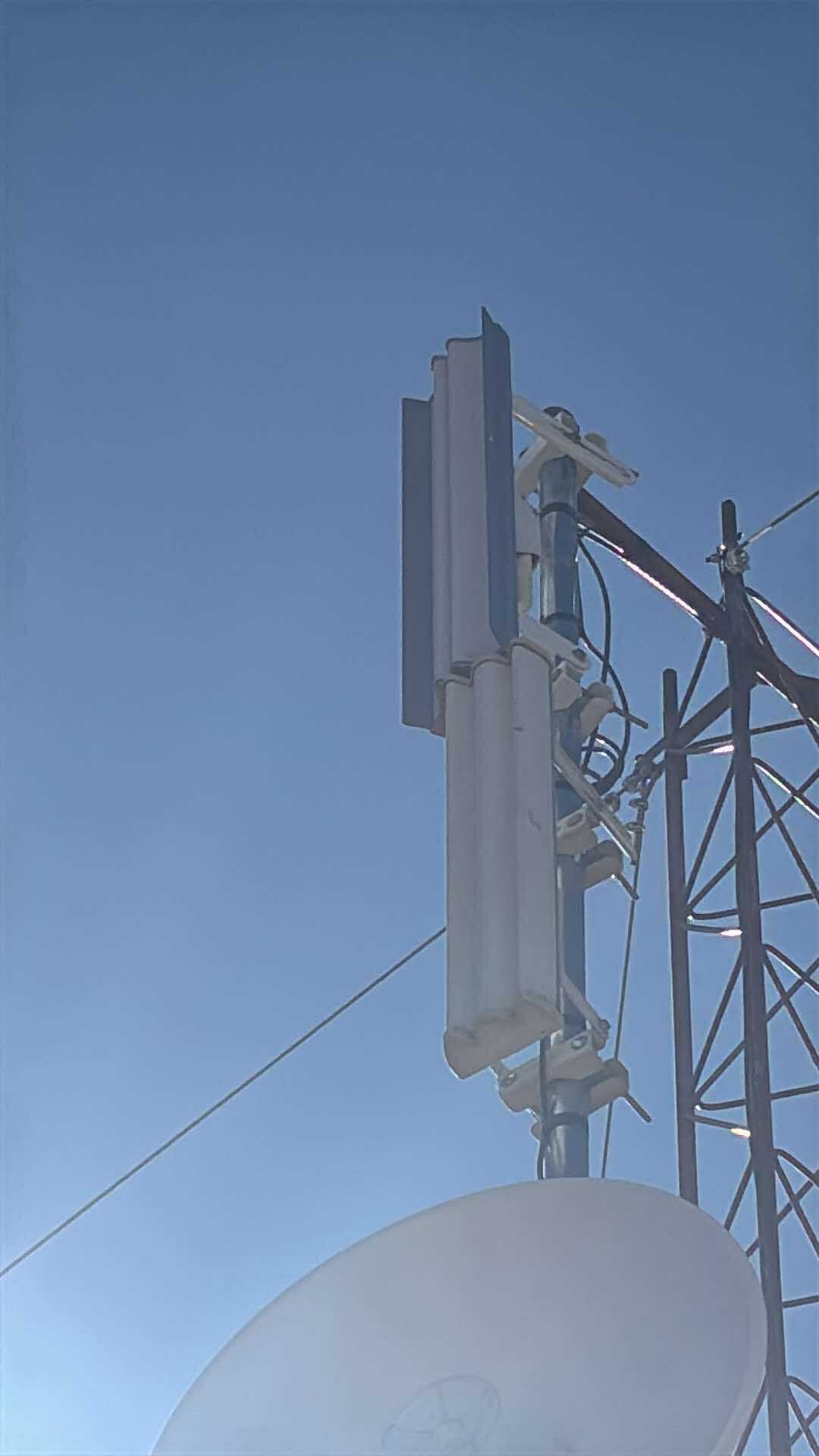
 Given the included picture in the post, proper answer would have been to use high-gain dish sectors.